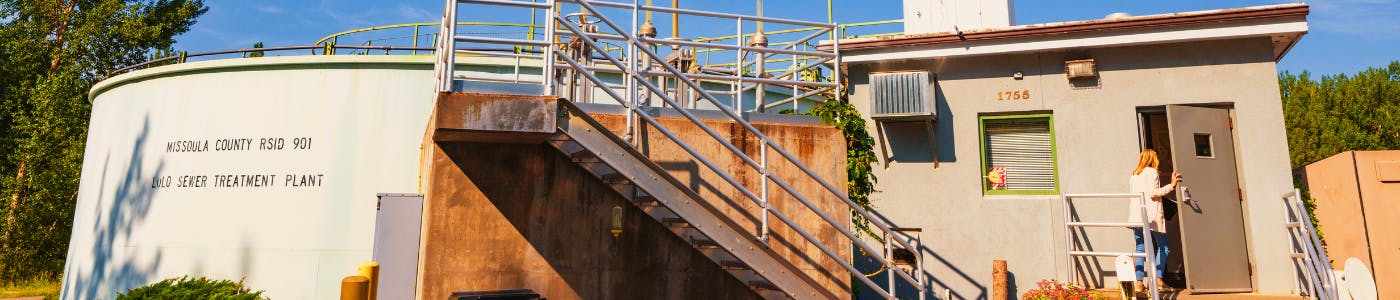
Lolo Water and Wastewater System Improvements
Project Overview
Missoula County is starting the public process to establish a new Rural Special Improvement District (RSID) to help fund needed repairs and upgrades to the water and wastewater system in Lolo.
Water system: The existing water system has reached full capacity, and no new connections are currently allowed. The County plans to upgrade wells #1 and #2, which will allow the district to pump at its full water right and expand capacity for approximately 400 new connections.
These new improvements will also provide backup generator support for emergency situations and mainline replacement at critical locations. For example, a mainline replacement is scheduled near Browman Way, which runs west underneath Highway 93 South and connects to existing pipe on Ridgeway near Coulter Pine Street. This mainline is at least 50 years old and is at the end of its useful life.
Wastewater system: A 2026 study determined the existing system can accommodate 400 additional connections and no major capacity upgrades are needed at this time. This project will replace existing headworks, influent and RAS pumps, cell liners and install new perimeter fencing.
Anticipated upgrades: Once Phase 2 improvements are completed, most new connections will be required to pay impact fees. This will be used to offset the cost of future system upgrades.
Phase 2 Funding
Phase 2 improvements are estimated to cost $7.3 million. The County will use a combination of funding sources to pay for these improvements and upgrades:
$1.75 million in federal funding that Western Montana's congressional delegation recently secured through the appropriations process (water project eligible only).
State Revolving Fund (SRF) is a federal-state partnership program that provides low-interest or zero-interest loans for local drinking water, wastewater and stormwater infrastructure projects. The County will issue bonds through this program, including $3.2 million for the water RSID and $2.3 million for the sewer RSID. These bonds will be paid off over 20 years via property tax assessments on the parcels within the district. Property owners will see the assessments on their tax bills starting in 2028.
What will residents pay?
Property owners will receive a notice later in October that will include the maximum principal tax assessment for their parcel. In total, Missoula County will collect up to $5.5 million from RSID 8490, excluding bond interest. The SRF loans that will be used for this project are low-interest loans through the State specifically designed for infrastructure projects, and the exact interest rates and total amounts per parcel cannot be determined until the bonds are issued.
There are 1,390 assessable parcels in the district. The assessments are proposed to be distributed at an equal amount per parcel. This would be $200 per year over a 20-year period (not including interest) OR $3,992.80 lumpsum ($2,294.24 water and $1,698.56 sewer).
Throughout the district, there are neighborhood parks and common areas that use these services (e.g., irrigation). Properties that share a common area will be assessed for their prorated portion of their common area. The maximum principal assessment for a parcel in the district will be $4,436.45 ($2,549.16 water and $1,887.29 sewer).
Timeline
Public Process:
- 1st Hearing – Oct. 8
- Staff will present a resolution to the board declaring their intention to create the RSID. The resolution outlines the district boundaries, project funding, assessments and next steps. Click here to view the approved notice of hearing.
- Publication, Mailing and Protest Period – Oct. 17-Nov. 20
- Notice of the Resolution of Intent and 2nd hearing is published in the newspaper on Oct. 17 and 24.
- By Oct. 17, all property owners within the district will be mailed a Notice of Hearing, explaining how to comment on and/or protest the creation of the district.
- The protest period is Oct. 17-Nov. 20. Protests should be delivered to the Missoula County Clerk & Recorder (in person, mail, or scanned and emailed). The protest must “be in writing, identify the property in the District owned by the protestor, identify whether the protest is against the Phase II Water System Improvements or the Phase II Sewer System Improvements or both, and be signed by all owners of the property.”
- 2nd Hearing – Dec. 3
- The commissioners will be presented with the protests received by the Clerk & Treasurer, take public comment and determine whether to move forward with the RSID.
- Subject to subsection 2(b), the district may not be created if more than 50% of property owners have protested the district. MCA 7-12-2112
- If approved, the commission will adopt a resolution creating the district.
Construction
Pending completion of the public process for the proposed RSIDs, Missoula County Public Works plans to bid the project toward the end of 2026 or beginning of 2027. Construction would tentatively begin in the spring of 2027 and is projected to be completed in November/December 2027.
Property Assessments
Bonds will be issued once construction is complete, and assessments will appear on tax bills the year after the bonds are issued. With an expected construction completion date of December 2027, the bonds would be issued in early 2028, with assessments appearing on tax bills in the fall of 2028.
The final year of assessments for RSID 8490 would be 2048. Beginning in 2028, taxpayers will have the option to pay off their full RSID 8490 assessment early and avoid the interest applied to their parcel.
-

Phone 406-258-4818 -

Phone 406-258-3772 -

Phone 406-258-4832 -

Phone 406-258-3425
-
 Lolo Water and Sewer Impact Fee Resolution NO. 2026-015.pdf (1.16 MB) (pdf)
-
Lolo RSID No. 901 - 2025 Water and Sewer Impact Fees Final Report 10.2.2025.pdf (1.03 MB) (pdf)
-
Phase II Water and Sewer Cost Summary Memo_draft (005).pdf (71.5 KB) (pdf)
-
DEQ Lolo Wastewater Denial Letter (596 KB) (pdf)
-
Lolo RSID 901 Water System Preliminary Engineering Report (7.92 MB) (pdf)
-
Lolo RSID 901 Wastewater System Preliminary Engineering Report (7.95 MB) (pdf)
-
Lolo Water Wastewater Improvements Handout (288 KB) (pdf)
-
Lolo Water Wastewater Improvements Open House Board (3.84 MB) (pdf)
-
RSID Timeline and Next Steps (103 KB) (pdf)
-
Lolo RSID boundaries (3.84 MB) (pdf)
-
Lolo Wastewater Capacity Tech Memo (March 2026) (464 KB) (pdf)
-
Notice of Passage of Resolution of Intention to Create RSID 8490 (101 KB) (pdf)

Certified mail and info received….thanks.
Here is to doing what is needed and doing it well.
I mentioned this at an earlier meeting and will say it again.
Cost and use wise it is crazy that every water using address doesn’t have a water meter and participate in tiered cost for water use. The sooner that happens the better.
Please explain why this is different than the RSID in East Missoula in 2001. We gave away the right to protest annexation and lost the ability for governance in exchange for the honor of having your water and sewer. Are you going to ask Lolo to unincorporate? This is the worst 25 year old marriage of all time, and please divorce us before shacking up again.
I don't want to pay for some elses developments... we're taxed enough .....let the developer PAY !!! Our sewer/water was fine till a "developer" moved in !!
Is there a better alternative to the current "Real Estate Value" pricing model? The current system only takes into account essentially the land value, not the Market value of a property. This can be extremely inequitable in some residential case. Especially for some mediaum and large residential parcels in lolo that are not even using sewer and water but are part of the RSID. For example, my family pays 3x the average rate on a property that is part of the RSID for which we currently do not use and are not even allowed to hook up the the current system...
Thank you to Shane and Cora at HDR for sharing updates over the past couple of years at Lolo Community Council meetings. Because of those, I have been well-informed about this process and am happy for it to move forward.
Thanks for putting this out. Looking forward to the meeting. This situation has been coming for a long time so it’s not a surprise to me. I’m curious to learn how the RSID would be formed.
Thanks again. I appreciate the information.