Wildfire-Prepared Missoula County: Community Wildfire Protection Plan
What’s coming up?
Join us for the second round of public engagement in November which includes Wildfire Prepared open houses with stations. All events will run from 6 to 7:30 p.m. on the following days:
- Monday, Nov. 16: Exploration Center in Missoula (1075 South Ave. W.)
- Tuesday, Nov. 17: Frenchtown Fire Station (16875 Marion St.)
- Wednesday, Nov.18: Bonner School (9045 Hwy. 200 E.)
- Thursday, Nov. 19: Sullivan Community Hall in Seeley Lake (3248 Hwy. 83)
If there isn’t a meeting in your community, please consider attending one nearby! You can also request staff attend a community council, neighborhood council or other community organization meeting after November. Future workshops will be held in different communities.
Project Description
Missoula County is in the beginning stage of updating the Community Wildfire Protection Plan (CWPP). This plan aims to increase individual and community capacity and resilience to prevent, prepare for, respond to and recover from wildfire.
What is a community wildfire protection plan?
A community wildfire protection plan is a guide to understand wildfire risks as well an outline action items residents, agencies and community organizations can take to reduce the impact of wildfires on our communities.
CWPPs were created under the 2003 federal law called the Healthy Forests Restoration Act. All CWPPs include three main elements:
- Working together: Local and state officials must work with community members, nonprofits and land managers (federal, Tribal, state, local government and private).
- Reducing fuels: A CWPP points out areas where thick or hazardous vegetation should be reduced and recommends how to do that.
- Safer homes: A CWPP explains what homeowners and communities can do to make buildings less likely to catch fire.
A CWPP is a community planning tool. It is not a regulation, a growth plan or an evacuation plan, but it can help guide those documents and tools.
Why update Missoula County’s CWPP?
Wildfire has always been part of Missoula County’s ecosystem. But fires are becoming more dangerous because of more homes in fire-prone areas, overgrown vegetation, difficult evacuations, the effects of climate change and a history of suppressing wildfires. The county’s last CWPP update was in 2018. Click here to read the full plan.
This update will use new data, look at how conditions have changed, and address new issues such as wildfire smoke. The plan will help the county, city and partners:
- Improve safety and preparedness for the public and first responders
- Support fire-adapted communities by focusing on the home ignition zone (HIZ) and smoke readiness
- Keep forests and landscapes healthy and resilient
- Seek funding for projects that reduce wildfire risk and make homes and communities more wildfire resistant
- Opens eligibility for federal grant funding to fund staff time for wildfire preparedness education and mitigation projects
Key terms
What is a fire-adapted community?
A fire-adapted community is one where people understand wildfire risk and take steps to prepare for it. This includes making homes, yards and neighborhoods more resilient so the community can better live with fire on the landscape.
What is the home ignition zone?
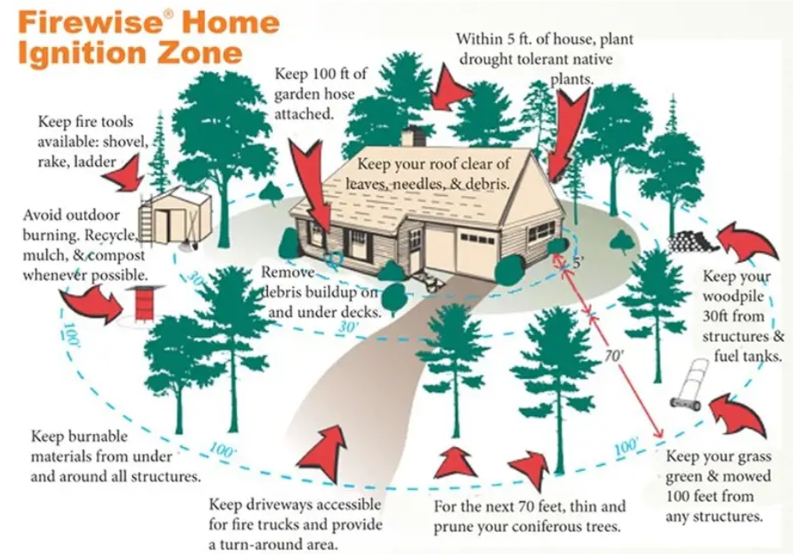
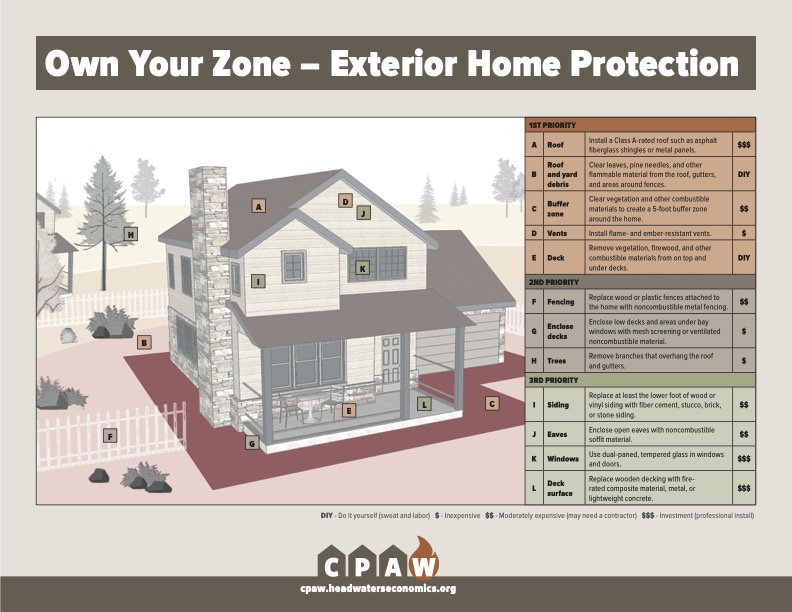
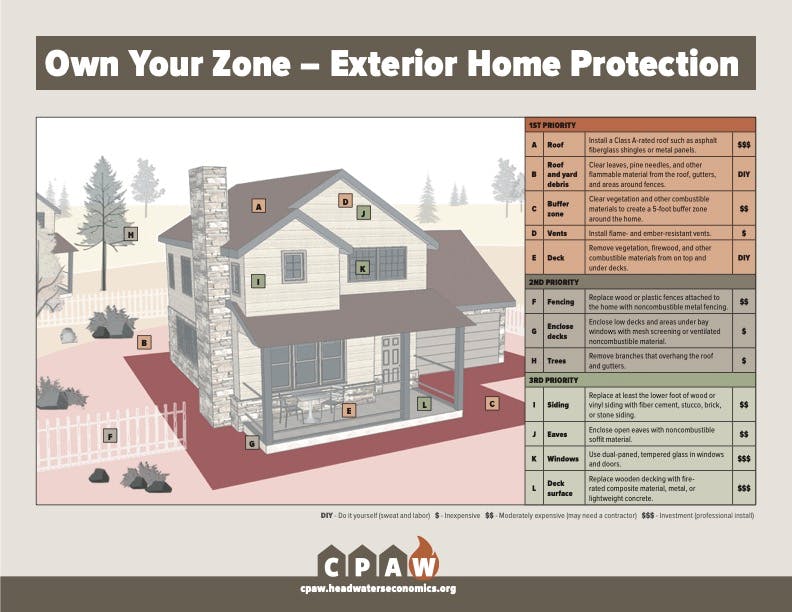
The home ignition zone (or HIZ) is one of the most important areas for homeowners to pay attention to for wildfire risk reduction. The HIZ is your home and the area immediately surrounding it that can be vulnerable to ember showers and creeping ground fire. In the HIZ it’s essential to use fire-resistant construction materials, screen vents and other openings and use non-flammable materials on the ground within 5 feet immediately surrounding the home. Listen to the podcast episode with Missoula County Wildfire Mitigation Specialist Olivia Anderson to learn more!
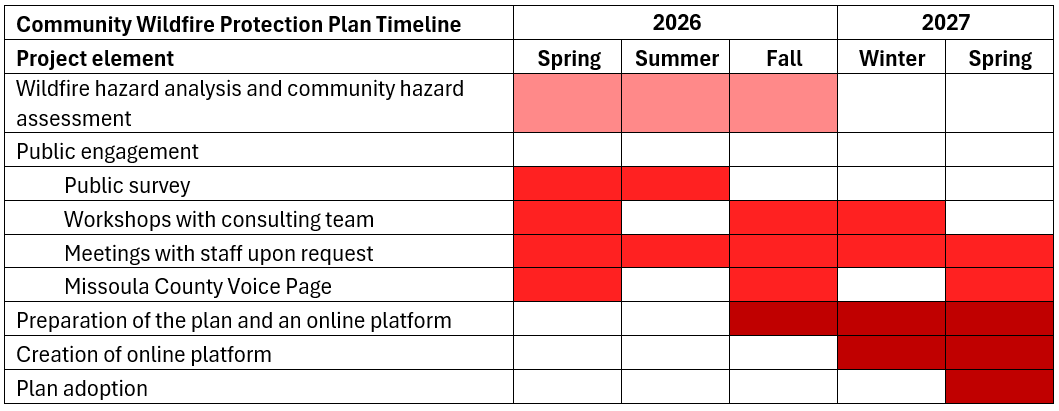
Project timeline
Home assessments: Make your home and property more wildfire resilient. Connect with our Wildfire Mitigation Program by submitting this form.
-
JH
Phone 406-258-4657 Email wildfireplanning@missoulacounty.us -
EL
Phone 406-258-4657 Email wildfireplanning@missoulacounty.us -
Office of Emergency Management Director
ABPhone 406-258-4657 Email wildfireplanning@missoulacounty.us -
Phone 406-258-4657 Email wildfireplanning@missoulacounty.us -
Wildfire Mitigation Program Manager
TLPhone 406-258-4657 Email wildfireplanning@missoulacounty.us -
Chief Lands & Communities Officer
CCPhone 406-258-4657 Email wildfireplanning@missoulacounty.us

To Missoula County Officials,
I am a Missoula County resident and an Environmental Science student here at UM commenting as a concerned community member. I support the updating of the CWPP and hope that the finalized plan can pair its wildfire risk priorities with measurable actions and timelines along with public updates.
I hope that current hazard and wildland urban interface information and data will be used to identify communities facing high risk and evacuation constraints. Treatments should be adapted to the local ecological environment with effects on habitat, water and erosion in mind. I believe that the plan should not imply that one treatment fits every landscape.
I also believe that the plan should address who realistically can use its programs by including outreach and support for residents who may need help with evacuation planning, smoke planning and monetary needs. Considering people with limited income, disabilities, language access needs or no reliable mode of transportation would be valuable. These actions would need to be coordinated with the City, County, fire districts, the DNRC, federal and Tribal land management and the community. Furthermore, a clear distinguishing of recommendations for private property vs public lands.
Finally, I believe that publishing annual progress showing completed projects, funding needs and allowing for community participation would be useful if the public can track whether or not recommendation actions are carried out. The Montana DNRC guidance page describes that CWPP materials should be used as collaborative planning tools to inform the public, so the public should play a large role in this.
Thank you for considering my comment.
To Missoula County officials,
As a concerned citizen who is interested in natural resource management and wildfire prevention, I support updating Missoula County’s Community Wildfire Protection Plan. I think the plan should focus on keeping people and homes safe while also protecting the health of local forests.
One recommendation I have is to provide more public education about wildfire prevention, especially for people who live near forests. Homeowners should know how to make their properties safer by removing flammable materials near their homes, keeping their yards maintained, and using fire-resistant building materials when possible. The county should also provide information about evacuation preparation and the health effects of wildfire smoke. These steps could help residents better prepare for wildfires and reduce the risk of damage to their homes (U.S. Congress, 2003).
I also think the plan should focus on managing forests in ways that reduce wildfire risks. Removing some hazardous vegetation through thinning and prescribed burning, when appropriate, can help reduce wildfire risk in certain areas. However, these projects should be planned carefully so they do not cause unnecessary damage to wildlife habitat, soil, or water resources. The county should work with local residents, Tribal governments, fire departments, and state and federal land managers to decide which areas need the most attention. Working together is an important part of developing an effective wildfire protection plan (U.S. Congress, 2003).
Finally, I recommend that Missoula County focus on communities that face high wildfire risks but may not have the resources to prepare their homes. Providing more education and financial support for wildfire prevention projects could help more people protect their properties. Overall, I think the updated plan should focus on keeping communities safe while also protecting the natural environment for future generations.
Thank you for considering my comments.
To Missoula County officials,
As a concerned citizen who is interested in natural resource management and wildfire prevention, I support updating Missoula County’s Community Wildfire Protection Plan. I think the plan should focus on keeping people and homes safe while also protecting the health of local forests.
One recommendation I have is to provide more public education about wildfire prevention, especially for people who live near forests. Homeowners should know how to make their properties safer by removing flammable materials near their homes, keeping their yards maintained, and using fire-resistant building materials when possible. The county should also provide information about evacuation preparation and the health effects of wildfire smoke. These steps could help residents better prepare for wildfires and reduce the risk of damage to their homes (U.S. Congress, 2003).
I also think the plan should focus on managing forests in ways that reduce wildfire risks. Removing some hazardous vegetation through thinning and prescribed burning, when appropriate, can help reduce wildfire risk in certain areas. However, these projects should be planned carefully so they do not cause unnecessary damage to wildlife habitat, soil, or water resources. The county should work with local residents, Tribal governments, fire departments, and state and federal land managers to decide which areas need the most attention. Working together is an important part of developing an effective wildfire protection plan (U.S. Congress, 2003).
Finally, I recommend that Missoula County focus on communities that face high wildfire risks but may not have the resources to prepare their homes. Providing more education and financial support for wildfire prevention projects could help more people protect their properties. Overall, I think the updated plan should focus on keeping communities safe while also protecting the natural environment for future generations.
An update to the CWPP given the growing danger of shifting fire regimes in recent years provides invaluable assistance to the community, provided the community is aware of it. Most people in Missoula are quite familiar with the dangers of worsening wildfire seasons, but there are still many who are uninformed about the subject. This is even more so the case with the recent surge in people moving to the area from out of state over the last several years. An aspect of updating the CWPP should include an improved method of public outreach to ensure all residents of Missoula County are made aware of the plan, how it benefits them, and why they should remain active as participants in it. In addition, some form of adaptation to a nature-based insurance plan should be added to the plan, not as a requirement but as a potential avenue for newly informed people to take an even more proactive approach to fire mitigation. While still developing as an idea, nature-based insurance can help protect our woodlands and people by placing the burden of the financial gap in mitigation actions on an agency that can spread this burden across all participating parties. While this will be an added expenditure (which no one would prefer), it can in turn lessen the rising cost of insurance in the Wildland-Urban interface (WUI) by providing another outlet of protection.
Every fire must be acknowledged with assets at risk. Every year, fires burn in Missoula County and compromise our clean air. Our air is filled with smoke. In this new plan, we should recognize clean air as a major value at risk during wildfire events. For this, we must focus on preventing high-severity fires. We need to allocate more money to fuel reduction throughout our forests. Additionally, lower-severity fires are easier to defend in a WUI fire. Missoula County could help pay for this by logging some of the nearby lands, working with the USFS and DNRC.
The city and county need to do more to stop conifer encroachment on open space. The Jumbo saddle area was a grassland when the city acquired it and now it is being allowed to turn into a wall of trees. The situation is the same in other open space surrounding the city. City and county should also encourage and partner with the Forest Service to do more select logging and fuel reduction in our urban interface and educate the public about the safety and ecological value of doing so.
I don't know the fire laws around homes in Huson. My concern is people burning. My very close neighbor on Mullan Rd has a home made version of a fire pit that they burn random things and it's so close to their home and sometimes unattended
Removed by moderator.